
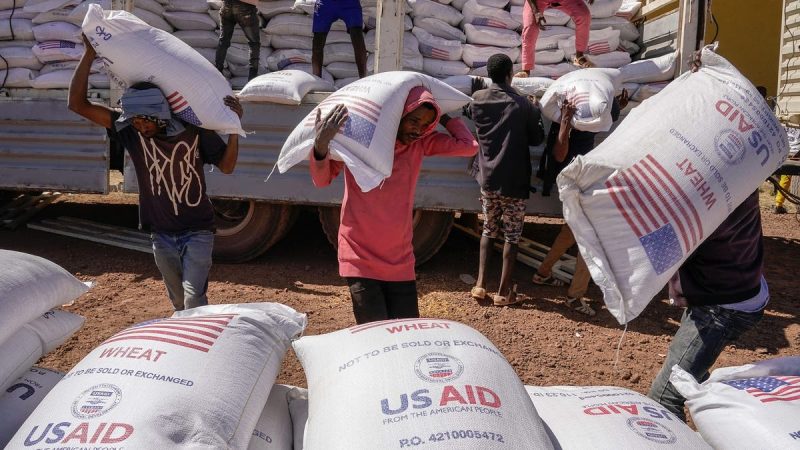
The key to Africa’s future is in increasing trade with the U.S., not in receiving aid from it, a message key analysts told Fox News Digital in the wake of President Donald Trump’s foreign aid freeze.
‘U.S. trade dollars exchanged with Africa massively exceed aid dollars granted,’ South African-based Frans Cronje, an advisor for the Yorktown Foundation for Freedom, told Fox News Digital.
Some $11 billion of USAid funds were reportedly spent in Africa in 2024, but trade between the U.S. and Africa during the same period was seven times higher – $71.6 billion, according to the Office of the U.S. Trade Representative.
Cronje said ‘the idea of helping people with aid may be admirable, but in practice achieves little in Africa by way of addressing the structural factors that underpin poverty. Trade, on the other hand, is a more viable route by which the U.S. can build strong relationships with Africa, and is also in line with President Donald Trump’s style of diplomacy through transactions.’
Cronje elaborated, saying, ‘Aid acts as a subsidy to bad governments, and thereby keeps them in power despite an absence of reform – whereas trade requires reforms and improving governance to be sustainable.’
Following the Trump administration’s policy change, Ledama Olekina, senator for Kenya’s Narok County, added, ‘We don’t need aid in Kenya; we can do it on our own!’ Posting on X on Jan. 28, Olekina wrote, ‘Relying on aid from the West limits our opportunities to be industrious and creative. From now on, we must learn to live within our means, eliminate corruption, and instill a spirit of patriotism in our citizens. Together, let’s build a brighter future for our country. Thank you @realDonaldTrump and @USAID it’s time!’
Anna Mahjar-Barducci, a senior research fellow at the Middle East Media Research Institute, told Fox News Digital that aid ‘does not help the needy, as foreign aid keeps the needy always being needy … international aid doesn’t go directly to the starving population, but to governments. The direct consequence is the growth of the role of the State in the economy of the recipient country, which does not offer incentives to (the) private sector’s development.’
She added, ‘Foreign aid has been financing central governments, which (has) ended up promoting statism, and discouraging the creation of an entrepreneurial culture. As a result, government bureaucrats became richer, and regular citizens got poorer. As British economist Peter Bauer put it: ‘Aid is a process by which the poor in the rich countries subsidize the rich in poor countries.’
Aid has other negative effects, according to Mahjar-Barducci, who added, ‘aid is providing governments, many of which are dictatorships, in Africa with freely usable cash, which not only discourages the creation of an entrepreneurial culture, but it also discourages steps toward peace in war-torn areas.
‘While many Westerners (mainly belonging to the radical left) criticized President Donald Trump’s decision to pause U.S. foreign aid, many African intellectuals welcomed the new administration’s policy.’
She pointed to a recent column by Nigerian expert Mfonobong Inyang, titled, ‘Wake Up Africa, Foreign Aid Is Not A Development Strategy.’ She said ‘in his article, he stated that foreign aid is meant to be a temporary relief and intervention, not an official policy of any country that seeks to assert its sovereignty.’
Mahjar-Barducci said, ‘Many African economists are saying that the suspension of USAID funding, offers an opportunity to redefine the African countries’ development strategy, and establish an ‘Africa-first approach,’ based on direct investments, innovation, partnerships, (and) empowering local governance.’
On Sunday, The Associated Press reported that some 1,600 posts at USAID would be eliminated after reviewing notices that were sent to USAID workers.
Enter the dragon. China is whipping its Belt and Road Initiative into a virtual frenzy in Africa. Beijing has invested over $700 billion in infrastructure development on the continent in the decade up to 2023, according to China’s commerce industry.
Cronje said that when it comes to Africa, China already believes in pushing trade, rather than aid, ‘in terms of both foreign investment flows and trade flows, China is a significantly more important economic partner for Africa than is the U.S. Since around 2010, Chinese trade with Africa escalated sharply in dollar terms whilst trade levels between the U.S. and Africa remained relatively flat.’
Mahdar-Barducci borrowed Ghanian economist George Ayittey’s phrase ‘Chopsticks Mercantilism’ to describe China’s policy in Africa, commenting on ‘China’s dexterity in striking deals with African leaders that were stacked in its own favor. Chinese multinational companies are investing in the African continent, in exchange for access to natural resources.’
Cronje stated that for the U.S., instead of aid, ‘trade is likely to be a more effective route to securing sound economic and diplomatic relations with Africa, as it helps to build sustainable African economies without being a direct cost to American taxpayers.’
Additionally, on China, Cronje concluded, ‘In many respects, the U.S. is having to play catch-up in Africa. For American policy makers, the trade and investment deficit relative to China should be a more important concern than the question of future aid flows.’