
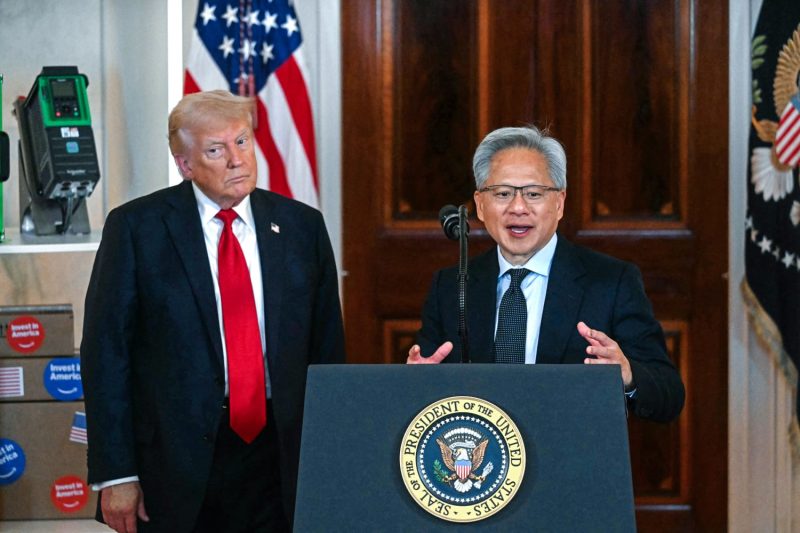
Nvidia and AMD have agreed to share 15% of their revenue from sales to China with the U.S. government, the White House confirmed Monday, sparking debate about whether the move could affect the chip giants’ business and whether Washington might seek similar deals.
In exchange for the revenue cut, the two semiconductor companies will receive export licenses to sell Nvidia’s H20 and AMD’s MI308 chips in China, according to the Financial Times.
“We follow rules the U.S. government sets for our participation in worldwide markets. While we haven’t shipped H20 to China for months, we hope export control rules will let America compete in China and worldwide,” Nvidia said in a statement to NBC News. “America cannot repeat 5G and lose telecommunication leadership. America’s AI tech stack can be the world’s standard if we race.”
AMD said in a statement that its initial license applications to export MI308 chips to China have been approved.
The arrangement crafted by President Donald Trump’s administration is “unusual,” analysts told CNBC, but underscores his transactional nature. Meanwhile, investors see the move as broadly positive for both Nvidia and AMD, which once more secure access to the Chinese market.
Nvidia’s H20 is a chip that has been specifically created to meet export requirements to China. It was previously banned under export curbs, but the company last month said it expected to receive licenses to send the product to China.
Also in July, AMD said it would resume exports of its MI308 chips.
At the time, there was no suggestion that the resumption of sales to China would come with conditions or any kind of revenue forfeiture, and the step was celebrated by markets because of the billions of dollars worth of potential sales to China that were back on the table.
On Monday, Nvidia shares rose modestly, while AMD’s stock was up more than 2%, highlighting how investors believe the latest development is not a major negative for the companies.
“From an investor perspective, it’s still a net positive, 85% of the revenue is better than zero,” Ben Barringer, global technology analyst at Quilter Cheviot, told CNBC.
“The question will be whether Nvidia and AMD adjust their prices by 15% to account for the levy, but ultimately it’s better that they can sell into the market rather than hand the market over entirely to Huawei.”
Huawei is Nvidia and AMD’s closest Chinese rival.
Uncertainty, nevertheless, still looms for both U.S. companies over the longer term.
“In the short term, the deal gives both companies some certainties for their exports to China,’ George Chen, partner and co-chair of the digital practice at The Asia Group, told CNBC. ‘For the long term, we don’t know if the U.S. government may want to take a bigger cut from their China business especially if their sales to China keep growing.’
Multiple analysts told CNBC that the deal is “unusual,” but almost par for the course for Trump.
“It’s a good development, albeit a strange one, and feels like the sort of arrangement you might expect from President Trump, who is a deal-maker at heart. He’s willing to yield, but only if he gets something in return, and this certainly sets an unusual precedent,” Barringer said.
Neil Shah, partner at Counterpoint Research, said the revenue cut is equivalent to an “indirect tariff at source.”
Daniel Newman, CEO of The Futurum Group, also posted Sunday on X that the move is a “sort of ‘tax’ for doing business in China.”
But such deals are unlikely to be cut for other companies.
“I don’t anticipate it extending to other sectors that are just as important to the U.S. economy like software and services,” Nick Patience, practice lead for AI at The Futurum Group, told CNBC.
The U.S. sees semiconductors as a strategic technology, given they underpin so many other tools like artificial intelligence, consumer electronics and even military applications. Washington has therefore put chips under an export control regime unlike that of any other product.
“Semiconductor is a very unique business and the pay-to-play tactic may work for Nvidia and AMD because it’s very much about getting export approval from the U.S. gov,” the Asia Group’s Chen said.
“Other business like Apple and Meta can be more complicated when it comes to their business models and services for China.”
Semiconductors have become a highly sensitive geopolitical topic. Over the last two weeks, China has raised concerns about the security of Nvidia’s chips.
Late last month, Chinese regulators asked Nvidia to “clarify” reports about potential security vulnerabilities and “backdoors.” Nvidia rejected the possibility that its chips have any “backdoors” that would allow anyone to access or control them. On Sunday, Nvidia again denied that its H20 semiconductors have backdoors after accusations from a social media account affiliated with Chinese state media.
China’s state-run newspaper Global Times slammed Washington’s tactics, citing an expert.
“This approach means that the US government has repudiated its original security justification to pressure US chip makers to secure export licenses to China through economic leverage,” the Global Times article said.
The Chinese government is yet to comment on the reported revenue agreement.
Trump’s deal with Nvidia and AMD will likely stir mixed feelings in China. On the one hand, China will be unhappy with the arrangement. On the other hand, Chinese firms will likely want to get their hands on these chips to continue to advance their own AI capabilities.
“For China, it is a conundrum as they need those chips to advance their AI ambitions but also the fee to the US government could make it costlier and there is a doubt of US ‘backdoors’ considering US has agreed for chipmakers to supply,” Counterpoint Research’s Shah said.
— CNBC’s Erin Doherty contributed to this report.