
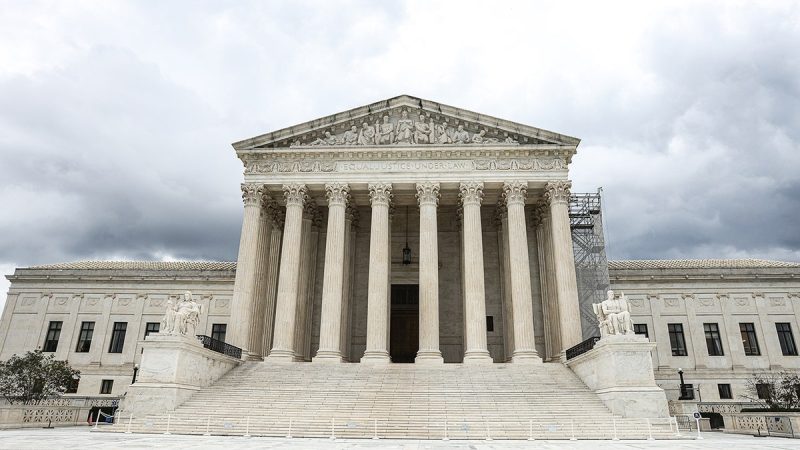
On Friday, the Supreme Court announced that it would hear challenges to President Donald Trump’s executive order to end birthright citizenship. The Fourteenth Amendment automatically makes all babies born on American territory citizens. Trump’s effort to overturn the traditional reading of the constitutional text and history should not succeed.
Ratified in 1868, the Fourteenth Amendment provided a constitutional definition of citizenship for the first time. It declares that ‘all persons born or naturalized in the United States, and subject to the jurisdiction thereof, are citizens of the United States and of the state wherein they reside.’ In antebellum America, states granted citizenship: they all followed the British rule of jus soli (citizenship determined by place of birth) rather than the European rule of jus sanguinis (citizenship determined by parental lineage). As the 18th-century English jurist William Blackstone explained: ‘the children of aliens, born here in England, are, generally speaking, natural-born subjects, and entitled to all the privileges of such.’ Upon independence, the American states incorporated the British rule into their own laws.
Congress did not draft the Fourteenth Amendment to change this practice, but to affirm it in the face of the most grievous travesty in American constitutional history: slavery. In Dred Scott v. Sandford (1857), Chief Justice Roger Taney concluded that slaves — even those born in the United States — could never become American citizens. According to Taney, the Founders believed that Black Americans could never become equal, even though the Constitution did not exclude them from citizenship nor prevent Congress or the states from protecting their rights.
The Fourteenth Amendment directly overruled Dred Scott. It forever prevents the government from depriving any ethnic, religious or political group of citizenship.
The only way to avoid this clear reading of the constitutional text is to misread the phrase ‘subject to the jurisdiction thereof.’ Claremont Institute scholars (many of whom I count as friends) laid the intellectual foundations for the Trump executive order; they argue that this phrase created an exception to jus soli. Claremont scholars Edward Erler and John Eastman argue that ‘subject to the jurisdiction thereof’ requires that a citizen not only be born on American territory, but that his parents also be legally present. Because aliens owe allegiance to another nation, they maintain, they are not ‘subject to the jurisdiction’ of the United States.
The Claremont Institute reading implausibly holds that the Reconstruction Congress simultaneously narrowed citizenship for aliens even as it dramatically expanded citizenship for freed slaves. There is little reason to understand Reconstruction — which was responsible for the greatest expansion of constitutional rights since the Bill of Rights — in this way.
This argument also misreads the text of ‘subject to the jurisdiction thereof.’ Everyone on our territory, even aliens, falls under the jurisdiction of the United States. Imagine reading the rule differently. If aliens did not fall within our jurisdiction while on our territory, they could violate the law and claim that the government had no jurisdiction to arrest, try and punish them.
Critics, however, respond that ‘subject to the jurisdiction thereof’ must refer to citizen parents or risk being redundant when being born on U.S. territory. But at the time of the Fourteenth Amendment’s ratification, domestic and international law recognized that narrow categories of people could be within American territory but not under its laws. Foreign diplomats and enemy soldiers occupying U.S. territory, for example, are immune from our domestic laws even when present on our soil. A third important category demonstrates that ‘subject to the jurisdiction thereof’ was no mere surplusage. At the time of Reconstruction, American Indians residing on tribal lands were not considered subject to U.S. jurisdiction. Once the federal government reduced tribal sovereignty in the late 19th and early 20th centuries, it extended birthright citizenship to Indians in 1924.
The Fourteenth Amendment’s drafting supports this straightforward reading. The 1866 Civil Rights Act, passed just two years before ratification of the Fourteenth Amendment, extended birthright citizenship to those born in the U.S. except those ‘subject to any foreign power’ and ‘Indians not taxed.’ The Reconstruction Congress passed the Fourteenth Amendment because of uncertainty over federal power to enact the 1866 Act. If the Amendment’s drafters had wanted ‘jurisdiction’ to exclude children of aliens, they could have simply borrowed the exact language from the 1866 Act to extend citizenship only to those born to parents with no ‘allegiance to a foreign power.’
We have few records of the Fourteenth Amendment’s ratification debates in state legislatures, which is why constitutional practice and common-law history are of such central importance. But the few instances in which Congress addressed the issue appear to support birthright citizenship. When the Fourteenth Amendment came to the floor, for example, congressional critics recognized the broad sweep of the birthright citizenship language. Pennsylvania Sen. Edgar Cowan asked supporters of the amendment: ‘Is the child of the Chinese immigrant in California a citizen? Is the child born of a Gypsy born in Pennsylvania a citizen?’ California Sen. John Conness responded in the affirmative. Conness would lose re-election due to anti-Chinese sentiment in California.
Courts have never questioned this understanding of the Fourteenth Amendment. In United States v. Wong Kim Ark (1898), the Supreme Court upheld the citizenship of a child born in San Francisco to Chinese parents. The Chinese Exclusion Acts barred the parents from citizenship, but the government could not deny citizenship to the child. The Court declared that ‘the Fourteenth Amendment affirms the ancient and fundamental rule of citizenship by birth within the territory, in the allegiance and protection of the country, including all children here born of resident aliens.’ The Court rejected the claim that aliens are not within ‘the jurisdiction’ of the United States. Critics respond that Wong Kim Ark does not apply to illegal aliens because the parents were in the United States legally. But at the time, the federal government had yet to pass comprehensive immigration laws that distinguished between legal and illegal aliens. The parents’ legal status made no difference.
President Trump is entitled to ask the Court to overturn Wong Kim Ark. But his administration must persuade the justices to disregard the plain text of the Constitution, the weight of the historical evidence from the time of the Fourteenth Amendment’s ratification and more than 140 years of unbroken government practice and judicial interpretation.
A conservative, originalist Supreme Court is unlikely to reject the traditional American understanding of citizenship held from the time of the Founding through Reconstruction to today.