
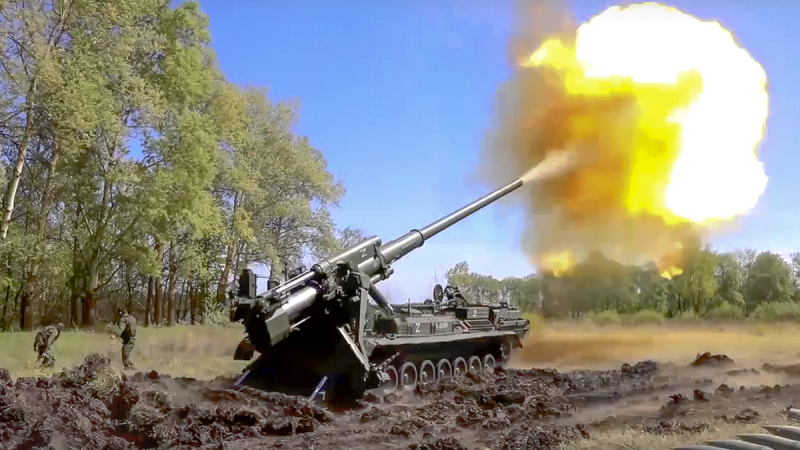
Russia’s military has been badly battered by its failure to conquer Ukraine, but Moscow is now rebuilding its war machine for the long haul, according to a new assessment from Estonia’s foreign intelligence service, even as the force it is fielding relies more on mass and attrition than military quality.
The report says Russia has suffered catastrophic losses since its full-scale invasion of Ukraine, with an estimated 1 million soldiers killed or severely wounded, draining its ranks and forcing the Kremlin to rely on mass mobilization rather than professional military strength.
Despite those losses, Estonian intelligence says the Kremlin is compensating by shifting toward mass and attrition, dramatically expanding weapons production and reorganizing its military around volume rather than quality, even as fighting in Ukraine continues.
Taken together, the assessment portrays a Russian military that has failed to defeat Ukraine, suffered historic manpower losses, and rebuilt around quantity over quality — leaving its true combat effectiveness increasingly in question.
Russia’s military-industrial complex has increased artillery ammunition production more than 17 times that of 2021, a surge the report says points to preparation for future conflicts rather than short-term battle needs, including the rebuilding of strategic stockpiles depleted during the war. Russia produced roughly 7 million artillery rounds in 2025 alone, according to the assessment.
The assessment cautions that Russia remains a diminished force compared with pre-war expectations — reliant on poorly trained recruits, convicts, foreign nationals and aging equipment — but warns that a degraded military rebuilt around attrition still poses a long-term challenge for Ukraine, NATO and European security.
Estonia, a frontline NATO state bordering Russia, has built one of Europe’s most detailed intelligence pictures of Russian military activity through its proximity, regional expertise and intelligence sharing with allies. Its annual assessments are closely read within NATO for its granular focus on Russia’s capabilities, limitations and long-term planning.
Nearly four years into the war, Estonia’s intelligence service says Russia has failed to achieve its core objective of subjugating Ukraine, which it describes as ‘more determinedly independent than ever before.’
President Donald Trump recently mocked Moscow’s performance, calling Russia a ‘paper tiger’ in a Truth Social post and questioning how a superpower could spend ‘four years fighting a war that should have taken a week.’
President Vladimir Putin has dismissed Western assessments of Russian military exhaustion as ‘wishful thinking.’ Speaking in Minsk, Belarus, Putin claimed Russia is actually preparing to ‘reduce defense spending’ starting in 2026, framing the surge in production as a completed objective rather than a sign of desperation.
‘We keep moving, keep advancing, and feel confident,’ Putin retorted to ‘paper tiger’ claims. ‘If we are a paper tiger, then what is NATO?’
But, the report concludes, ‘Russia remains dangerous despite its incompetence.’
The intelligence service also stresses that Russia is not expected to launch a military attack against Estonia or any other NATO member in the coming year, a judgment it says is likely to remain unchanged if current levels of deterrence are maintained.
According to the report, Russia is ‘merely feigning interest in peace talks,’ using negotiations to buy time, ease pressure on its economy and reset conditions for a longer confrontation rather than to end the war on terms acceptable to Ukraine.
To offset its manpower losses, Russian authorities have built a nationwide recruitment system that increasingly relies on coercion and desperation rather than voluntary service, with regional governments under pressure to meet monthly enlistment quotas at any cost, the report says.
Recruitment efforts now focus heavily on ‘socially vulnerable groups,’ including the unemployed, chronic debtors, detainees, individuals under judicial supervision, and those suffering from alcohol or drug addiction, according to the assessment. Labor migrants and foreign nationals have also been swept up into the system as traditional recruitment pools dry up.
The report ties Russia’s military strategy to mounting economic and social strain at home, saying the prolonged war has hollowed out civilian sectors of the economy while pushing the state to prioritize defense spending at the expense of living standards. Nearly all nonmilitary sectors are either in recession or stagnation, the assessment says, increasing the risk of social instability in the years ahead.
The intelligence service also documents the use of foreign students — particularly from African countries — who are lured with promises of employment or residency extensions, then redirected into military training and sent to the front. Hundreds of foreign nationals from countries including Zambia, Tanzania, Cameroon and Nigeria have been deployed to Russian combat units, often with little training and limited understanding of the terms they agreed to.
These foreign recruits are frequently assigned to units used to absorb heavy losses, shielding better-trained formations and underscoring what the report describes as Russia’s growing reliance on expendable manpower rather than professional soldiers.
The assessment describes widespread lawlessness inside the armed forces, citing abuse of power, corruption, theft, alcoholism and drug use as persistent problems that have eroded discipline and combat effectiveness. Frontline units, the report says, are increasingly composed of individuals who ‘under normal circumstances should not be entrusted with weapons.’
Russia also has relied heavily on convicts to replenish its ranks. Between 150,000 prisoners and 200,000 prisoners were recruited from Russian detention facilities between 2022 and 2025, many of them convicted of serious violent crimes and granted pardons in exchange for frontline service, according to the report.
Despite the erosion of professionalism across its ranks, Estonian intelligence cautions against interpreting Russia’s military shortcomings as a reduction in threat. Instead, it says Moscow has adapted by embracing a model built around attrition, firepower and expendability, rather than maneuver warfare or elite units.
For NATO planners, the concern is that a Russia rebuilt around mass firepower and expendable manpower lowers the threshold for prolonged, high-casualty conflicts, even if Moscow struggles with complex operations.
The report emphasizes that Russia has exhausted much of the military stockpiles it inherited from the Soviet Union and exposed systemic problems within its armed forces, yet continues to invest heavily in rebuilding ammunition reserves and unmanned systems that could be used beyond Ukraine.
Not all analysts agree that ‘mass’ is Russia’s only path. A recent report from the Royal United Services Institute (RUSI) suggests 2026 will instead be the ‘year of hybrid escalation.’ With conventional options ‘foreclosed by economic constraints,’ researchers William Dixon and Maksym Beznosiuk argue the Kremlin is pivoting to a ‘thousand cuts’ strategy of cheaper, deniable sabotage across Europe.
‘We must prepare not for a resurgent Russia but for a desperate one,’ the report warns.
This shift replaces traditional combat with an agile network of ‘disposable’ saboteurs— recruited via encrypted apps for arson and infrastructure attacks — designed to fracture Western support for Ukraine from within.